Building Financial Reserves: How Much Cash Should Your MSP Keep?
Cash reserves are one of the quietest measures of business maturity. Revenue, growth rate, and EBITDA tend to get the spotlight, but the size and structure of your reserves often decide whether an MSP can absorb a setback, seize an opportunity, or sleep well at night. For a business model built on recurring revenue and tight delivery margins, the answer to "how much cash should we keep?" is more nuanced than a single rule of thumb.
This guide breaks down how MSP leaders can think through reserve sizing, where to hold the cash, and how to balance liquidity with the need to keep investing in the business.
Why Reserves Matter More for MSPs Than Most Businesses
Managed service revenue looks predictable on paper. Monthly contracts, multi-year agreements, and steady renewals create the impression that cash will always be there when needed. The reality is more complicated. Client churn, delayed payments, vendor cost increases, and the lumpy timing of annual license renewals can all create short-term gaps even in a healthy MSP.
On top of that, MSPs carry obligations that do not pause when revenue dips. Payroll, software licensing, and technology refreshes continue on their own schedule. Without a reserve sized for that reality, a single rough quarter can force decisions that hurt long-term value, like cutting staff or skipping investments. Building reserves is not about being conservative for its own sake. It is about giving the business the breathing room to act strategically when conditions change. Strong budgeting and forecasting techniques provide the foundation for knowing what that reserve actually needs to cover.
What "Enough" Actually Looks Like
The most common benchmark for small and midsize businesses is three to six months of operating expenses held in liquid reserves. For MSPs, that range is a starting point rather than a finish line. The right number depends on the shape of your client base, your fixed cost structure, and how exposed you are to single points of failure.
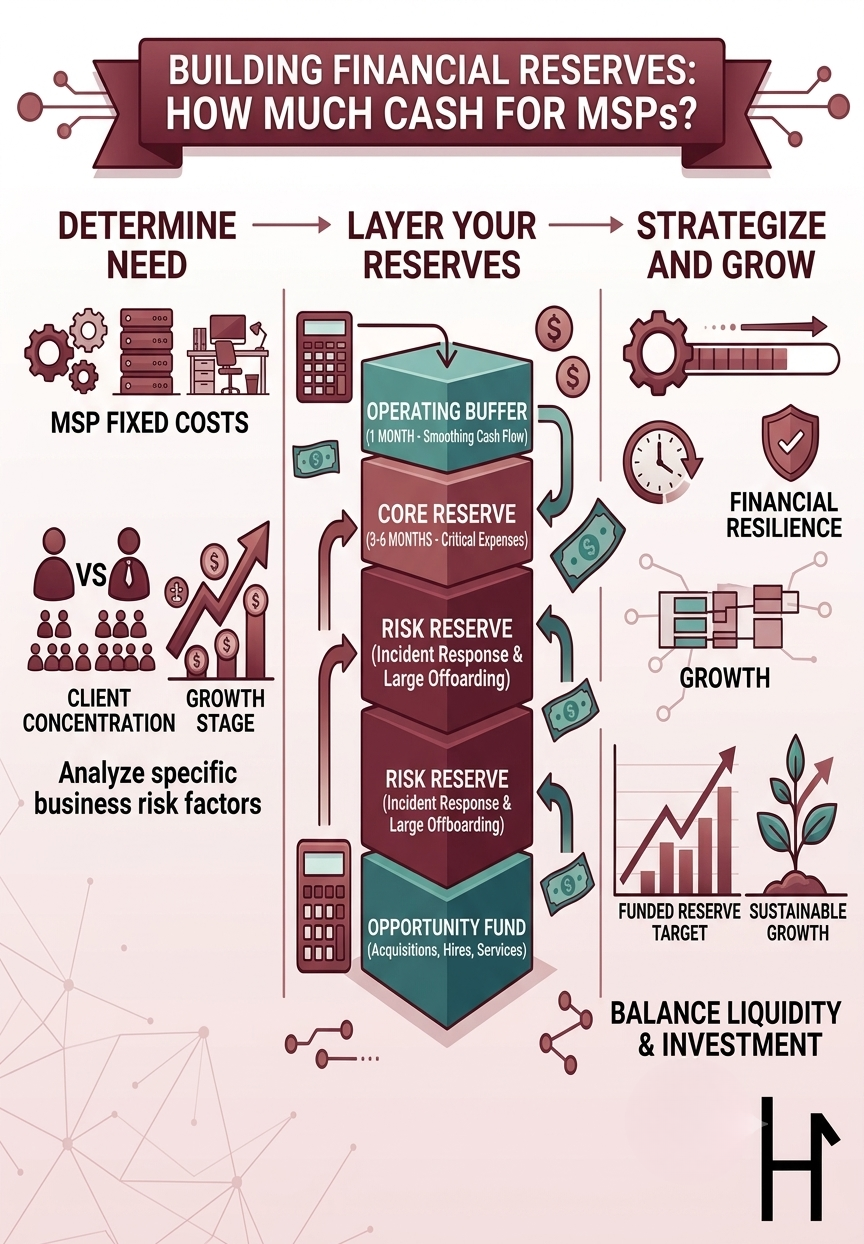
A useful way to think about it is to layer your reserves rather than aim for one big number. Each layer has a different purpose, sits in a different place, and gets touched under different conditions.
The layered reserve approach typically looks like this:
Operating buffer: One month of operating expenses kept in your primary checking account to smooth normal timing differences between receivables and payables.
Core reserve: Three to six months of fixed operating expenses, including payroll, rent, recurring software, and essential vendor obligations, held in a high-yield business savings or money market account.
Opportunity fund: A separate pool earmarked for acquisitions, new service lines, or major hires. Usually built only after the core reserve is fully funded.
Risk reserve: A smaller, dedicated pool for known but irregular costs such as cybersecurity incident response, large client offboarding events, or insurance deductibles.
Owner distribution buffer: For S corp owners and partnerships, a holding pool that smooths quarterly distributions without depleting operating cash.
Layering reserves prevents the trap of treating all cash as available cash. Each pool has a job, and that clarity makes it much easier to resist the temptation to spend funds that were set aside for a different purpose.
Factors That Should Move Your Number Up or Down
The right reserve target is not the same for every MSP. A business serving a hundred small clients on month-to-month agreements faces a very different risk profile than one with twelve enterprise clients on three-year contracts. Reserve planning needs to reflect those differences, not just industry averages.
Several specific factors deserve close attention when setting your target. Each can pull your reserve number higher or lower depending on how it applies to your business.
Client Concentration
If your top three clients represent more than thirty or forty percent of revenue, your reserve target should sit at the higher end of the range. Losing a single anchor client can create an immediate hole that smaller, diversified MSPs simply do not face.
Contract Length and Auto-Renewal Terms
MSPs with long contracts and strong auto-renewal language can hold somewhat less in reserves because revenue visibility is stronger. Those operating on month-to-month or short-term agreements need a deeper cushion to absorb churn surprises.
Fixed Versus Variable Cost Ratio
The more of your cost base is fixed, primarily salaried staff and committed software, the larger your reserve should be. Variable cost structures flex with revenue. Fixed structures keep running whether revenue arrives or not.
Growth Stage and Investment Pace
A rapidly growing MSP investing heavily in sales, engineering, and tooling can justify a leaner reserve only if growth capital is available from another source. Without that backup, aggressive investment without adequate reserves is one of the fastest ways to create a cash crisis.
Exposure to Seasonal or Cyclical Demand
Even though MRR smooths much of the seasonality, project work, hardware refresh cycles, and client budget timing can create predictable dips. Planning for these patterns through targeted cash flow strategies helps right-size the reserve rather than overbuilding it.
Walking through each factor honestly produces a reserve target grounded in your actual business, not a generic benchmark.
How to Build Reserves Without Stalling Growth
The hardest part of reserve building is not the math. It is the discipline of routing cash into reserves while still funding the investments that drive growth. Done well, the two goals reinforce each other. Done poorly, they compete for every available dollar.
Practical ways to build reserves without slowing the business include automating monthly transfers from operating to reserve accounts, allocating a fixed percentage of each month's net cash flow to reserves before considering discretionary spend, and treating annual prepayment discounts from vendors as a chance to recycle savings into the reserve pool. A regular mid-year financial review is a useful checkpoint to assess whether contributions are on track and whether the target itself needs to shift based on changes in the business.
Tying reserve contributions to a clear strategic plan also helps. When leadership can see how reserves support specific goals, such as a planned acquisition, expansion, or capacity build, contributions feel like investments rather than constraints. This is where financial scenario planning earns its keep, by showing exactly how different reserve levels affect the range of moves the business can make.
Where to Hold the Cash
Once you know how much to hold, the next question is where. Holding too much in a low-yield checking account leaves money on the table. Holding too much in less liquid vehicles defeats the purpose of having a reserve in the first place. The goal is a balance between yield and accessibility, with the mix shifting by reserve layer.
For most MSPs, the operating buffer stays in the primary business checking account, the core reserve sits in a high-yield business savings or money market account at the same institution for easy transfer, and the opportunity fund may include short-term treasury instruments or laddered CDs that offer better yields without locking the cash up for too long. Spreading larger reserve balances across more than one banking relationship also reduces the impact of any single institution issue.
When Strategic Guidance Pays Off
Reserve strategy is one of the areas where outside perspective consistently delivers value. An advisor who has helped many MSPs through both growth and disruption can spot risks and opportunities that are hard to see from inside the business. They can also push back on assumptions that have gone unchallenged for years.
Working with a partner who provides financial consulting tailored to MSPs means your reserve plan reflects current industry conditions, your specific client mix, and the strategic goals you have set. It also creates accountability, which makes a real difference when the pressure to spend reserves on something exciting starts to build. For MSPs ready to fold reserve planning into a broader sustainable financial future, structured advisory support turns a static cash balance into an active part of the growth plan.
Conclusion
The right cash reserve is the one that lets your MSP keep making good decisions when conditions are bad and bold decisions when conditions are good. By layering reserves with a clear purpose, sizing them to your specific risks, and building them without sacrificing growth investment, you create a financial foundation that supports the business through every cycle.
If you would like a partner to help you set reserve targets, build the discipline to hit them, and align them with your bigger goals, reach out to the Hasenbank Accounting Services team to start the conversation.
Hasenbank Accounting Services provides remote accounting support to Managed Service Providers and IT businesses. With over 27 years of accounting experience and 23 years supporting the IT industry, we are focused on making the financial aspects of your MSP business one less thing to worry about. Contact us today to see how we can help you.