How to Account for Software Licensing in MSP Financial Statements
Software licensing sits at the center of how a Managed Service Provider operates and how it gets paid. From PSA platforms and RMM tools to the dozens of vendor licenses you resell to clients, every contract carries an accounting consequence that flows into your financial statements. When licensing costs are recorded inconsistently, margins blur, profitability looks distorted, and decisions get made on shaky numbers.
Getting licensing accounting right is less about following a single rulebook and more about building a repeatable process that matches each cost to the period it actually belongs in. This guide walks through the categories, the methods, and the controls that help MSP leaders produce financial statements they can trust.
Why Software Licensing Is Uniquely Complex for MSPs
Most MSPs handle two very different sides of software licensing at the same time. On one side, you purchase licenses for tools your team uses internally, things like ticketing systems, documentation platforms, and remote monitoring software. On the other, you resell or pass through vendor licenses to clients as part of managed service agreements. Each side has its own timing, billing structure, and reporting requirements.
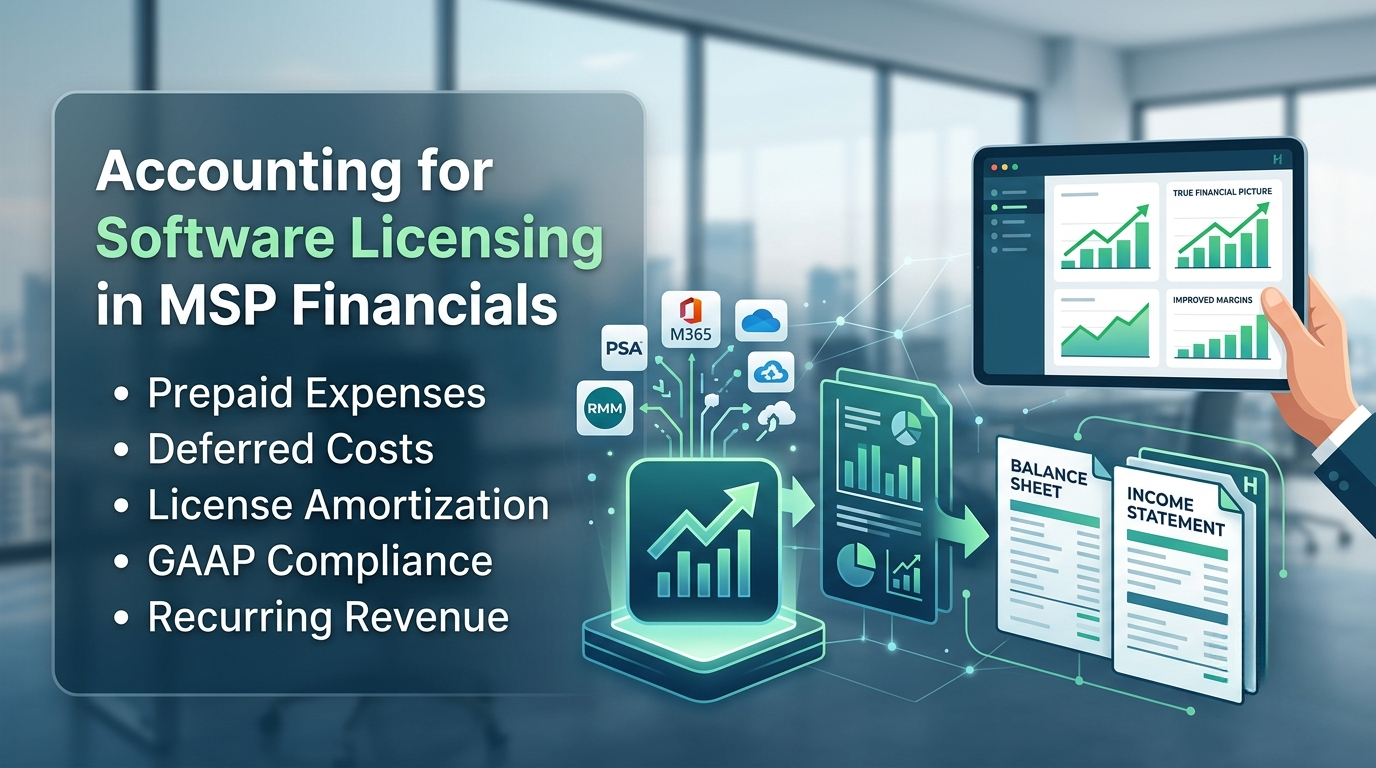
This dual reality means a single transaction can touch revenue recognition, cost of goods sold, prepaid assets, and deferred liabilities all at once. Without a clear categorization framework, expenses can get bundled into the wrong line items, hiding the true cost of service delivery. Solid accounting services tailored to the MSP model help untangle these layers so the numbers in your statements actually reflect what is happening in the business.
Categorizing Software Licensing Costs Correctly
Before any entry hits your books, every license needs a clear home. The categorization decision shapes how the expense moves through your income statement and balance sheet, and it influences how readable your financial reports will be for leadership, lenders, and investors.
Most MSP licensing costs fall into one of the following categories. Knowing where each contract belongs prevents the common mistake of treating every license as a generic operating expense.
Internal-use software licenses: Tools your team uses to deliver services, such as PSA, RMM, documentation, and cybersecurity platforms. These typically flow through operating expense or, in some cases, are capitalized.
Reseller or pass-through licenses: Licenses you purchase from a vendor and bill to the client, often at a markup. These belong in cost of goods sold against the matching client revenue.
Bundled licenses inside managed service agreements: Licenses embedded in a flat monthly fee where no separate line item appears on the client invoice. Allocation here directly affects gross margin.
Annual or multi-year prepayments: Licenses paid upfront for a future service period. These should be recorded as prepaid expenses and amortized.
Trial, sandbox, or evaluation licenses: Short-term tools used for testing. Usually expensed immediately rather than capitalized.
When each cost is assigned to the right bucket, gross margin reporting becomes accurate, and leadership can finally see which service lines are actually pulling their weight.
Timing: Matching License Costs to the Right Period
The accrual principle is the backbone of clean licensing accounting. Whether you pay monthly, annually, or for a three-year term, the expense should be recognized over the period in which the license delivers value. Paying for a twelve-month subscription in January and expensing the full amount that month overstates costs in Q1 and understates them for the rest of the year.
This becomes especially important for MSPs running on a recurring revenue model. If revenue is recognized monthly but license costs are recognized in a lump sum, the matching principle breaks, and gross profit appears to swing wildly from period to period. The fix is straightforward in concept: prepaid licenses sit on the balance sheet as an asset, then move to the income statement in equal portions across the service term.
For pass-through licenses billed to clients, the timing should mirror the revenue. If the client is billed monthly for a Microsoft 365 seat, the cost of that seat should also hit the books monthly, not in the period the vendor invoice landed.
Building a Repeatable Licensing Workflow
Strong financial reporting depends on a workflow that captures each license consistently from purchase through reporting. Without a defined process, errors compound, and reconciling vendor statements at year-end becomes a painful exercise. The following steps form a reliable foundation that any MSP can adopt.
Here is a practical sequence to keep licensing accounting clean and audit-ready throughout the year:
1. Create a Master License Register
Maintain a central record of every active license, including vendor, license type, quantity, renewal date, billing frequency, and assigned client or internal team. This single source of truth eliminates the guesswork that happens when licensing data lives in vendor portals, spreadsheets, and inboxes. It also makes year-end reviews dramatically faster.
2. Standardize Purchase Coding
Every license purchase should be coded at the point of entry using a consistent chart of accounts. Train whoever approves vendor invoices on the categorization rules so that internal-use, reseller, and bundled licenses are never lumped together. Consistency at the point of entry is what prevents painful reclassification work later.
3. Automate Amortization Schedules
For prepaid and multi-year licenses, set up amortization schedules inside your accounting platform so monthly entries post automatically. Pairing your PSA with the right accounting platform, such as through a QuickBooks integration, reduces manual journal entries and the errors that come with them.
4. Reconcile Licenses Against Vendor Statements Monthly
Compare the license register to vendor billing every month, not once a year. Discrepancies like seat count drift, unused licenses, or duplicate subscriptions are easier to catch and correct close to the source.
5. Map Licenses to Client Contracts
Tie each pass-through or bundled license to the client agreement it supports. This mapping is what makes gross margin reporting by client or service line possible, and it surfaces unprofitable contracts before they drag down the business.
Following these steps consistently transforms licensing from a messy line item into one of the cleanest, most useful sections of your financial reporting.
Reporting Licensing Costs in Your Financial Statements
Once the workflow is in place, the impact shows up across all three primary financial statements. On the income statement, properly classified licenses sharpen the line between cost of goods sold and operating expense, making gross profit margin meaningful again. On the balance sheet, prepaid license assets and deferred revenue from prebilled client licenses reflect the obligations and resources that are easy to miss in cash-basis reporting. On the cash flow statement, the timing of large annual prepayments becomes visible, which matters for liquidity planning.
For MSPs that follow generally accepted accounting principles, there are also specific rules around capitalizing certain implementation costs and amortizing them over the useful life of the software. Whether or not capitalization applies depends on the nature of the license and the implementation work involved, which is where guidance from an accounting partner pays off.
Controls and Oversight That Protect Your Numbers
Even the cleanest workflow needs a layer of oversight to stay reliable as the business grows. Software licensing is a category where small errors compound quickly because new seats, vendor changes, and renewal pricing happen constantly. Internal controls turn a good process into a durable one.
Effective internal financial controls for licensing typically include approval thresholds for new vendor contracts, periodic review of the license register against active employees and clients, segregation of duties between purchasing and reconciliation, and quarterly margin reviews by service line. These checks catch issues early, before they distort a full quarter of reporting.
For growing MSPs, bringing in vCFO services can add an extra layer of strategic oversight. A vCFO can interpret what licensing trends mean for gross margin, model the financial impact of vendor changes, and help leadership make pricing decisions grounded in accurate cost data rather than rough estimates.
Conclusion
Software licensing is too central to MSP operations to be treated as an afterthought in the books. With clear categorization, accrual-based timing, a repeatable workflow, and strong oversight, licensing becomes a source of clarity rather than confusion in your financial statements. The result is sharper margin visibility, cleaner audits, and better decisions about pricing, vendors, and service lines.
If your current licensing accounting feels more reactive than strategic, it may be time to bring in a partner who understands the MSP model from the inside out. Contact Hasenbank Accounting Services to talk through how a tailored approach can turn your licensing data into a real financial advantage.
Hasenbank Accounting Services provides remote accounting support to Managed Service Providers and IT businesses. With over 27 years of accounting experience and 23 years supporting the IT industry, we are focused on making the financial aspects of your MSP business one less thing to worry about. Contact us today to see how we can help you.